A LAB NOTEBOOK FOR YOUR BODY
Track everything. Learn nothing?
Your ring scores your sleep. Your watch logs your zone 2. A lab runs your panels twice a year. And none of it talks to any of it. The Longevity Protocol Journal is the missing layer — 13 weeks where protocols get designed, supplements go on trial, and bloodwork deltas, not vibes, decide what stays.
The problem
Three data sources. No memory.
Your wearable
Scores every night, logs every session. Then the week ends and the score resets. Capture without memory.
…and none of it talks to any of it.
Your labs
Two PDFs a year with forty numbers each. The most important data you own, filed in an email you'll never reopen.
…and none of it talks to any of it.
Your stack
Six supplements, three of which you started "to see." Nobody is checking whether the seeing ever happened.
…and none of it talks to any of it.
Capture isn't the problem. Synthesis is. That layer doesn't ship with any device — so it's a book.
How it works
Five parts. One quarter.
- 01Baseline
Biometrics, ten fitness markers, four structured bloodwork panels. You can't attribute a change you never measured from.
- 02Protocol
The quarter's bet, written down: objectives with numbers, training template, sleep rules, and a supplement table with the column most stacks are missing: Drop if…
- 03Thirteen weeks
Plan on the left page, review on the right. Ten minutes on Sunday, thirty seconds a day.
- 04N=1 experiments
Six blocks. One variable, a success criterion you commit to before day one, and a verdict page where blank is not an option.
- 05Retest
Same labs, same tests. The Delta Table grades the quarter in numbers you can defend. Attribution column included; "unknown" is a legal answer.
Look inside
The pages are the product.
On a phone, scroll the spreads sideways or pinch to zoom.
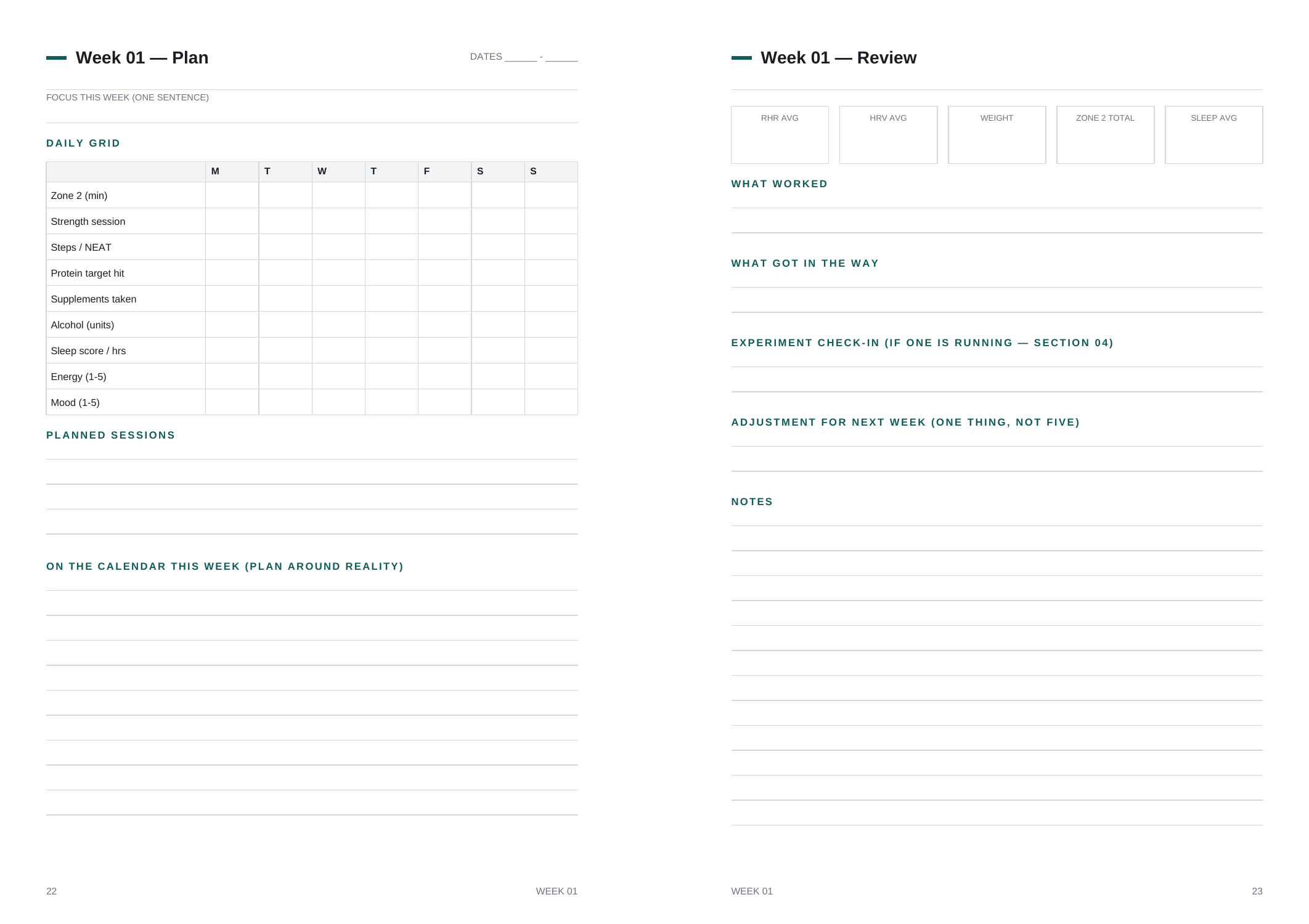
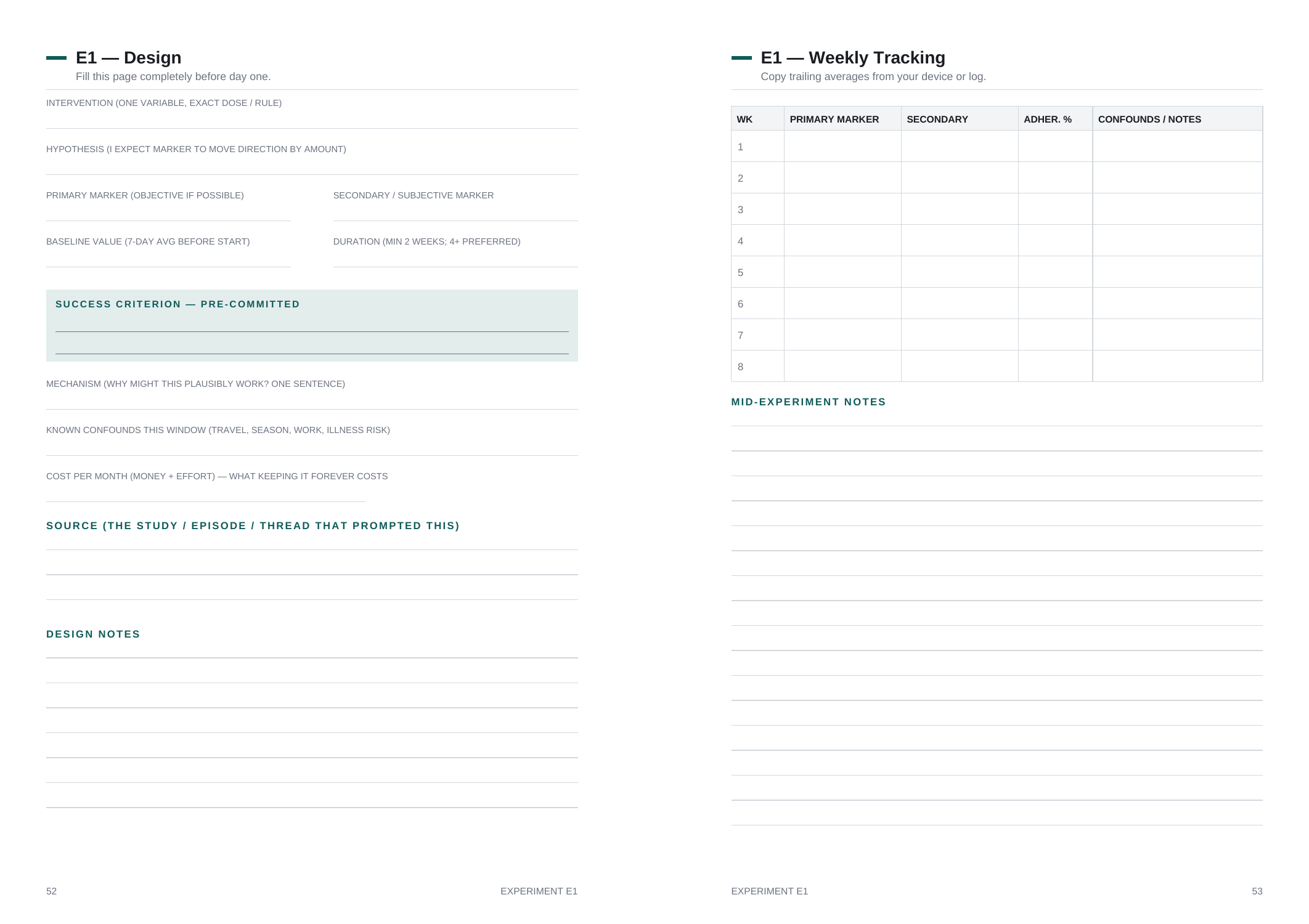
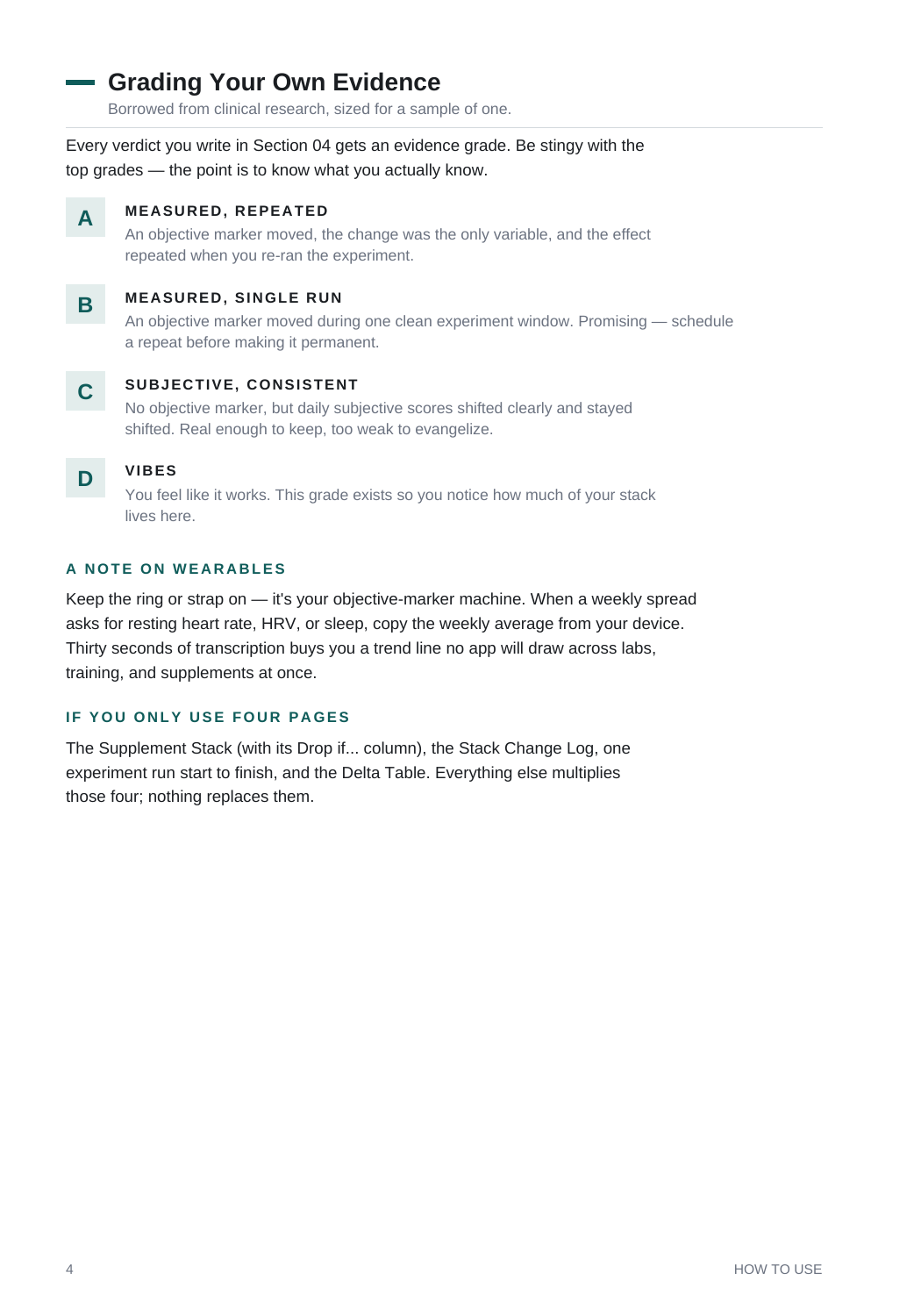
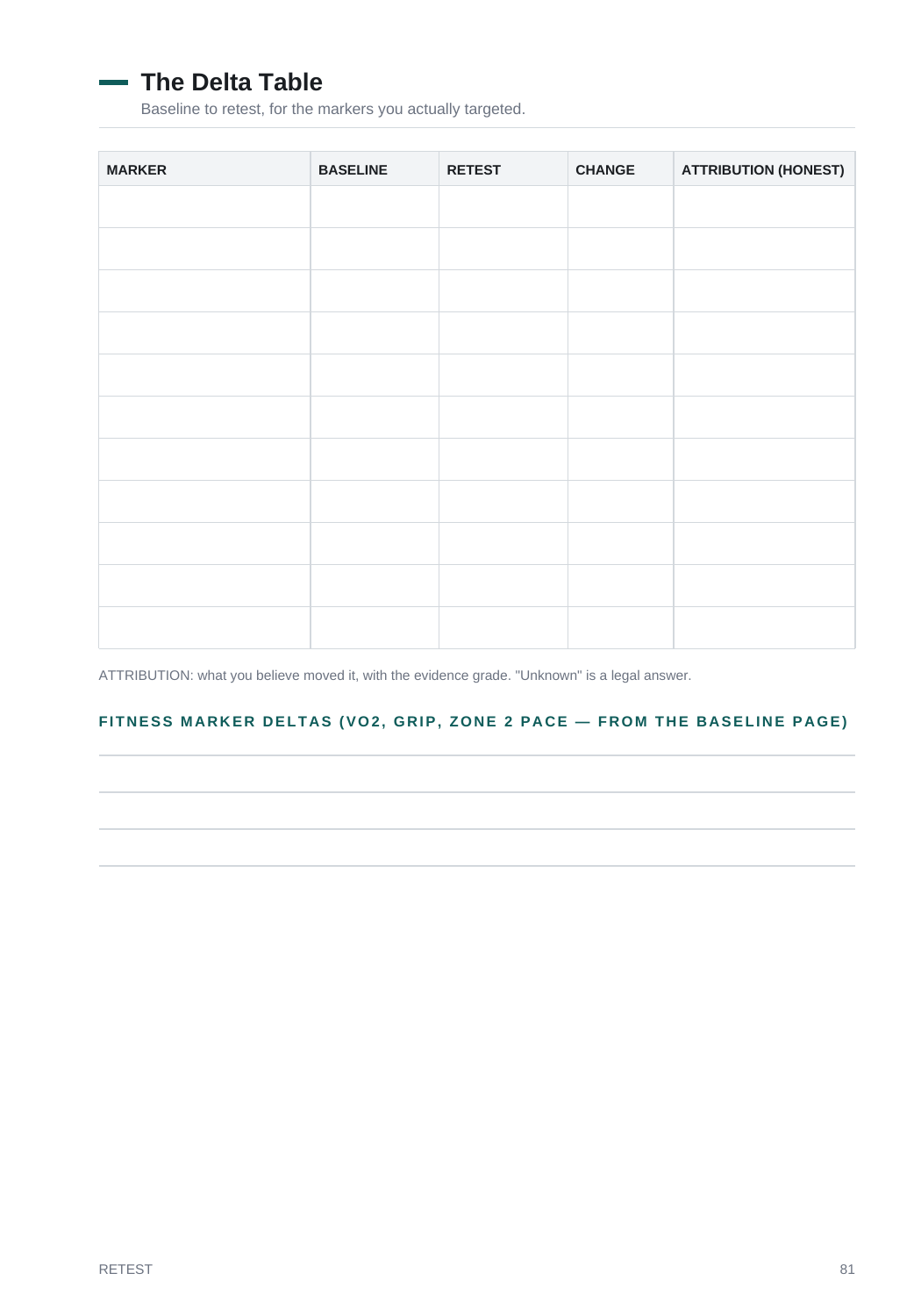
96 pages · 7×10" paperback · one journal covers one 13-week quarter.
Fit
Who it's for. Who it isn't.
For you if
- you get bloodwork beyond the annual physical and actually read it
- you own a wearable and trust its trends more than its scores
- your supplement drawer has survivors and suspects
- you'd rather drop something confidently than keep everything hopefully
- you can give it ten minutes on a Sunday
Not for you if
- you want a program to follow — this contains zero workout plans and zero diet rules
- you've never had labs drawn and don't plan to (it still works on wearable data, but you'd be buying half the book)
- you want an app — the entire point is that it isn't one
- you expect a journal to change your biomarkers. It won't. It tells you what did.
Free sample
Try one week before you buy.
The sample PDF has the how-to pages, the evidence-grading system, a full weekly spread, and an experiment design page. Print the spread, run one real week on it. If Sunday's review doesn't earn the ten minutes, the journal won't either.
One email with a PDF. No sequence, no drip. Unsubscribe is one click.
FAQ
Questions, answered plainly.
Don't my apps already track this?
They capture; they don't synthesize. The journal is where a quarter of capture becomes three decisions. And paper is the point: no notifications between you and the verdict.
Why paper, in 2026?
Because the failure mode of health data is review, not capture. A designed page you fill on Sunday beats a dashboard you never open. Ten minutes a week, thirty seconds a day.
Is this medical advice?
No. It is a structure for your own information. Labs, supplements, and training changes belong in conversation with your clinician.
I don't get regular bloodwork — is it still useful?
Yes. The weekly spreads and experiments work on wearable and subjective markers alone; the bloodwork pages wait until you do. The Delta Table is the payoff, though, so you'd be using half the book.
How long does one journal last?
One quarter: 13 weeks. By design. A quarter is the honest window to look at what a protocol did to your markers.
How is this different from a fitness journal?
Fitness journals log workouts. This runs experiments: pre-committed success criteria, confound tracking, and a verdict page where KEEP, DROP, or RETEST must be ticked.
The journal
One variable at a time.
A 96-page lab notebook for one quarter. $24.95.